



Have you ever “switched off” and let AI write that important email—then felt yourself fading from it? You’re not alone. The numbers below aren’t meant to scare you—they’re here to show the bigger picture: where AI truly amplifies us, and where the trade-offs begin.
The 2025 landscape in three numbers
- 34% of U.S. adults say they’ve used ChatGPT; among adults under 30 it’s 58%—roughly double since 2023. Pew Research Center
- ~60% of jobs in advanced economies are exposed to AI; about half may benefit via productivity, while the other half may see lower labor demand. Globally, ~40% of jobs are affected. IMF+1
- Data-center electricity consumption is set to more than double to ~945 TWh by 2030, with AI the biggest driver. IEA+1
Where AI is helping
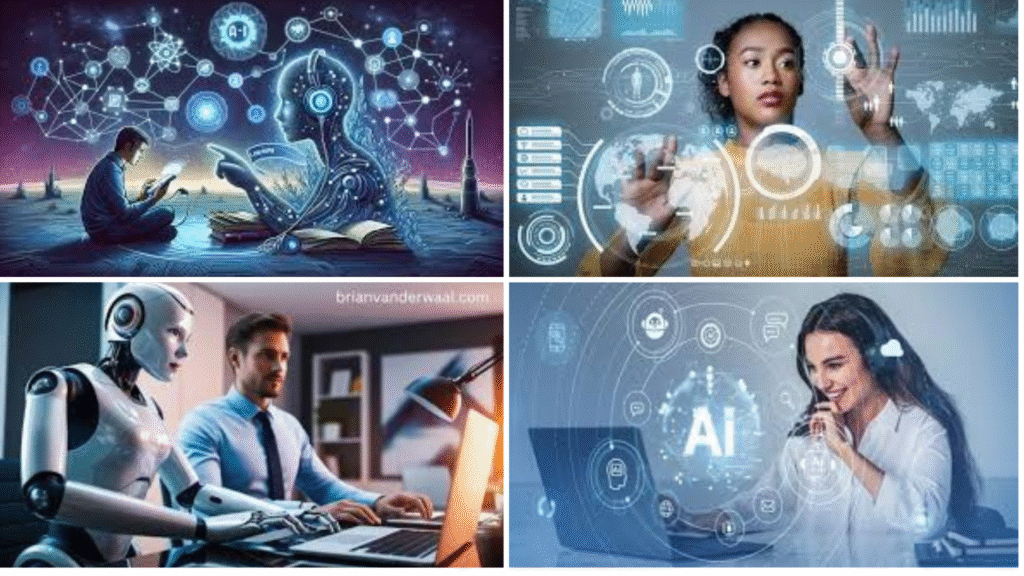
- Everyday productivity: drafting, summarizing, brainstorming, transcripts, and lightweight analysis—tasks that “get life done.”
- Access to know-how: conversational explanations lower the barrier to learning and language.
- What people actually do with it: new analyses of 1.5M+ user chats show most activity is non-work and practical guidance, with programming ~4% of queries—evidence that AI is currently a general-purpose helper more than a niche dev tool.
Where communities worry
- Information quality & trust: half of Americans expect AI to harm the news ecosystem over the next 20 years. Skepticism is rational: speed isn’t accuracy.
- Jobs & inequality: AI exposes different roles in different ways; policy and reskilling determine whether exposure becomes lift or loss. IMF
- Energy & infrastructure: the compute we celebrate has a grid-level footprint; efficiency and clean power matter.
- Health & safety boundaries: in healthcare and other high-stakes domains, AI never replaces clinicians; the WHO urges human oversight, transparency, and careful data governance.
Act now: a 30-60-90 day plan
- Individuals / small teams: adopt the 3–2–1 rule
3 independent sources when facts matter • 2 minutes to think before prompting • 1 final cross-check after AI’s answer. - SMEs: pick one clear use case (e.g., customer-email replies) and appoint one accountable owner. Track: response time, error/complaint rate.
- Communities / schools: host monthly “AI Office Hours” at a library or campus so people can get hands-on help with real tasks.
- Safety note (health/legal/finance): label clearly—AI doesn’t replace professionals; route to official help when needed.
Day 31–60 — Optimize & be transparent
- Individuals: define No-AI Zones (final decisions on money/health/legal remain human).
- SMEs: keep a change log when you switch models; add an “AI-assisted” badge on AI-helped content; apply a lightweight NIST RMF cycle (goal → risks → tests → fixes).
- Communities: pilot a one-page GenAI policy for schools (disclose AI use, set evaluation rules, protect privacy).
Day 61–90 — Make it durable
- Individuals: run a personal A/B: with vs. without AI on one skill (writing, studying, coding). Keep what truly adds value; drop the rest.
- SMEs: schedule quarterly TEVV (hallucinations, bias, complaint KPIs). Favor efficient models/providers with credible clean-energy roadmaps. IEA
- Communities: publish a public dashboard (Office Hours attendance, % cases escalated to human experts). Invite local businesses to share real case studies.
The big idea—and a community call to action
The new era isn’t human vs. machine. It’s responsible AI users vs. blind AI users. GrowthBase invites everyone to help set the community rules of the road: use AI to expand capability—without surrendering human judgment. Join our monthly AI Office Hours, bring a real task, and share what worked (and what didn’t)—so the whole community levels up together.
Sources
- Pew Research Center — U.S. adoption of ChatGPT: 34% adults; 58% under 30.
- IMF (Kristalina Georgieva) — ~60% jobs in advanced economies exposed; global impact ~40%.
- IEA — Data-center electricity ~945 TWh by 2030; AI as main driver. IEA
- WHO — Ethics & governance guidance for LMMs in health (human oversight). World Health Organization
- NIST AI RMF 1.0 — Govern, Map, Measure, Manage NIST Publications
- Usage patterns — Most chats are non-work; programming ~4% (1.5M+ ChatGPT chats report). The Washington Post
- Public sentiment about AI & news — Half expect negative effects on journalism. Pew Research Center